
AIFA to introduce updated dossier guidance ahead of publication of the first JCA report
With the first Joint Clinical Assessment (JCA) reports expected in May 2026, The Italian Medicines Agency (AIFA) has joined other key European HTA bodies in updating legislation to facilitate the integration of JCA outputs in their HTA process. In this article, Nick Stringfellow explores the key features of the updated guidance in relation to the both the EU JCA and those more relevant to Italian national policy.
On the 23rd of December 2025, AIFA published the “Guidelines for filling in the dossier to support the Health Technology Assessment of a medicinal product for reimbursement and pricing by the National Health Service”, which will come into effect on the 1st of April 20261. The reason for the update was cited as a necessity due to the changed regulatory framework imposed by the EU Regulation on Health Technology Assessment (HTAR), the implementing acts adopted by the European Commission, and the guideline techniques and procedures adopted by the HTA Coordination Group. These guidelines are intended to cover the TN1 – TN7 categories defined by AIFA, which include:
- TN1: New medicinal products, orphan drugs and/or new indications for active ingredients already on the market
- TN2: Medicines and/or indications already marketed
- TN3: Medicines and/or indications with active ingredients whose patent has expired or is about to expire
- TN4: Revisions to the conditions for admission to reimbursement
- TN5: Special procedures – Las 648/96
- TN6: Other special procedures
- TN7: Parallel imports
Here we explore the main points of interest for manufacturers from the updated guidance, focusing on those related to the JCA and those more closely related to Italian national policy.
Timelines

Providing manufacturers are able to submit a dossier shortly after the JCA report publication, AIFA have set the timeline in which the negotiation procedure must be concluded by the Scientific and Economic Commission (CSE) at 180 days. This is provided that the dossier is received completed with relevant documentation attached. For orphan drugs and drugs of exceptional therapeutic relevance, this process can be shortened to a “fast track” 100 days at the request of the manufacturer.
Once the pricing and reimbursement conditions have been negotiated, these will remain valid for a period of 24 months from the date of publication in the Official Journal. There is an assumption that these conditions will then be renewed for a further 24 months unless one of the parties submits a proposal to modify the current conditions at least 60 days before the expiration of the agreement. For example, the CSE could wish to reassess the data and renegotiate the conditions at 24 months if there was significant uncertainty in the original data package.
Key updates related to the JCA
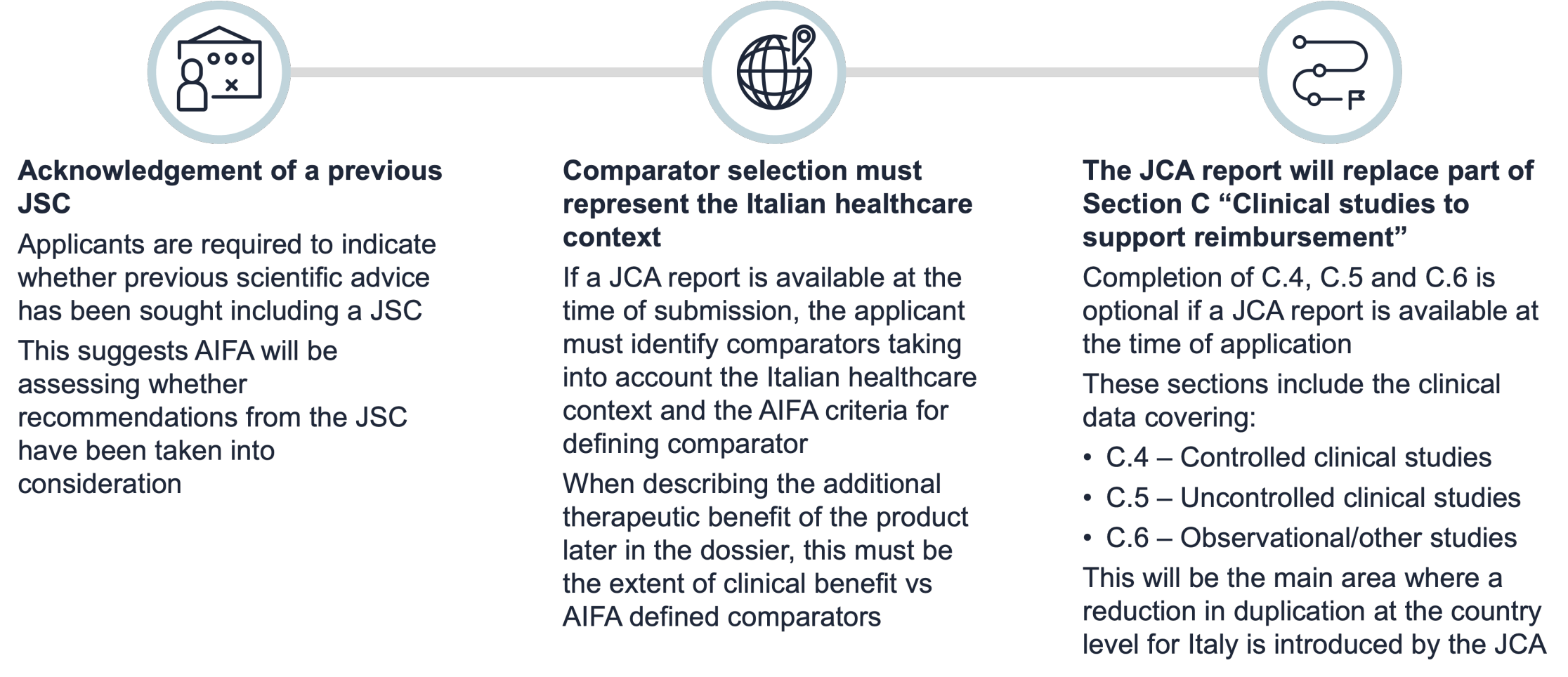
Acknowledgement of JSC
One of the main considerations for companies deciding whether or not to undergo a JSC is the potentially negative implications if the advice given is considered to be unfeasible and therefore not followed. There is still significant uncertainty on the level of influence a previous JSC will have at the country level. However, the updated guidance from AIFA now specifically includes JSCs as a type of scientific advice that the applicant must indicate as being previously sought. This suggests AIFA will be assessing whether recommendations from the JSC have been taken into consideration during product development, which is likely to be of even more relevance if AIFA was one of the HTA bodies initially involved in the JSC process for that product.
Transferring the JCA PICOs to the Italian healthcare context
The guidance also indicates how AIFA will consider the potentially high number of PICOs that could be included within the final JCA report. For products where a JCA report is available at the time of submission of the dossier, the applicant is required to identify the relevant comparators, taking into account criteria defined by AIFA. Preferably, comparators should be available within the National Pharmaceutical Formulary, used in the Italian healthcare context for the target population or any subpopulations, and have an impact on outcomes recognised as clinically relevant and validated for the pathology in question. Alternatively, comparators will also be recognised if they are:
- Authorised under Law 648/98 and therefore able to be prescribed at the expense of the NHS
- Treatments recommended at the time of submission in national guidelines or guideliens updated in line with European/international standards
- Considered best supportive care
- A ‘well-established pharmacological therapeutic strategy’
The document later describes how the added therapeutic benefit of a product should be considered in the dossier. Guidance states that the extent of clinical benefit provided must be in comparison to AIFA defined comparators, therefore excluding any clinical data that doesn’t align with the Italian healthcare context describe above.
A JCA report will significantly shorten section C of the dossier “Clinical studies to support reimbursement”
One of the main aims of the JCA to reduce duplication at the country level. For Italy, if a JCA report is available at the time of dossier submission, completion of C.4, C.5 and C.6 will now be optional. These sections cover the clinical studies to support reimbursement, including:
- C.4 – Controlled clinical studies
- C.5 – Uncontrolled clinical trials
- C.6 – Observational studies
The details specifying exactly what should be included in these sections (if a JCA report is not available) are included in the appendix. This includes a tabular summary of each study including:
- Treatments included (i.e., intervention and comparator)
- Endpoints and the related definitions
- The results and analysis
There is then a study flow chart followed by the main text section describing the following study details:
- Title, Background and Objectives
- Methods
- Effectiveness Results
- Safety results
- Final evaluation of the study
Indirect treatment comparisons (ITCs) and studies not belonging to the other typologies may also be submitted as part of this section. The guidance states that ITCs must now have appropriate statistical methodology in line with technical documents developed in the scope of HTAR i.e., in line with the ITCs that will be submitted during the JCA.
Endpoints
Regarding endpoints, the guidance states that validated Patient-Reported Outcomes Measures (PROMs) and Patients-Reported Experiences Measures (PREMs) will be taken into account if they are able to show a significant improvement in the QoL of patients. In rare and ultra-rare diseases, improving quality of life also includes pain and the ability to perform daily or work-related activities. If these endpoints are actively requested by Italy during the PICO scoping process for certain products now that they are included as options in the national guidance may influence future study protocols, particularly for rare diseases that lead to significant pain for patients.
Updates to national policy
Innovation application
When considering the quality of evidence criterion for innovation status, special consideration will be given to applicants that can declare the research plan and/or product development has been conducted primarily Italy. This may be if the preclinical development of a drug is conducted in a research centre within the national territory or if the principal investigator of at least one clinical phase (Phase I, II, III) belongs t[JW1] [NS2] o the national territory.
Law 648/98 (off-label reimbursement)
In the updated guidance, AIFA acknowledges that the applicant for access to a drug through Law 648/98 does not necessarily correspond to the company that is the marketing authorisation holder. In this instance, the company will receive immediate formal communication from AIFA of the initiation of the procedure, with a request that they actively participate in the process.
Introduction of a new simplified procedure (TN8)
Although the document doesn’t specify the dossier requirements and instead refers manufacturers to a separate document on the AIFA online portal, the guidance does acknowledge the need to simplify the process of defining reimbursement and pricing for specific product categories, packaging and regulatory typologies[JW3] . The simplified procedures now covered by the TN8 category include:
- Biosimilar or equivalent drugs (including reimbursement of extensions of indication already reimbursed to the originator)
- Parallel import drugs (simplified version of the TN7 category)
- Class C(NN) packages
- Refundability of new packages due to modification of primary packaging
- Reimbursement of new packages due to a change in the dosage units or dosages from those of drugs already reimbursed
Updates to economic evaluation
Budget Impact Analysis
The updated guidance introduces two criteria for when submission of a budget impact analysis will be mandatory as part of a TN1. This includes if:
- The expected turnover for the first three years of reimbursement is equal to or exceeding €50 million, and/or
- The expected expenditure of the product is significantly offset (i.e., by at least 30%) by lower spending on either other drugs or other healthcare resources.
Economic evaluation
For economic evaluations, the cost-effectiveness of a technology should be evaluated by determining the incremental cost per life year gained and per quality-adjusted life year (QALY) gained from the point of view of the NHS. This should be over a long-term time horizon of between 5 to 10 years. Where appropriate, it may also be suitable to consider cost-effectiveness from a societal perspective or show the analysis results in terms of Net Monetary Benefit. These types of cost-effectiveness analyses (CEA) will now be mandatory for TN1 submissions. The guidance introduces an exclusion for CEA specifically for TN1.3 (extension of therapeutic indications of the originator drug), in the case that:
- The extension concerns subgroups of patients of an indication already reimbursed (i.e., extension to pediatric age, modification of reimbursement criteria)
- The weighting of the new indication in terms of the overall turnover is less than 15% across each of the first 3 years of the forecast
Within the appendix section, the information required for CEA is specified in tabular form. This includes direct costs from the NHS perspective (i.e., drug costs and administration), other health resources (i.e., hospitalisations, visits, tests, procedures, other therapies) and other direct and indirect costs from a societal perspective.
The guidance also specifies that, for cost utility analyses, it is preferable to use a generic questionnaire administered to the patients directly concerned and the assessment of health status is based on the preferences of the general Italian population. To this point, AIFA recommends the use of EQ-5D-5L or adaptations of this (i.e., EQ-5D-Y for paediatric patients).
Data extrapolation
For model data that has been extrapolated over the time horizon, applicants are requested to:
- Identify the point in time from which the model incorporates extrapolated data rather than data observed in the study
- Describe the methodology used for data extrapolation
- Test all possible distributions
- Evaluate the goodness of fit of the model to the observed data on the basis of statistical criteria, visual inspection and clinical plausibility
- Justify the assumptions used to extrapolate data beyond the time horizon of the study or after discontinuation of treatment
- Indicate the percentage of LY and QALY gained after treatment discontinuation and after the period of observation of clinical study data on the total LYs and QALYs gained across the entire horizon analysis timeframe
- Verify the external validity of the extrapolated data by comparing with external or registry evidence
- Explore uncertainty by considering alternative scenarios and more conservative assumptions from the perspective of the NHS
The updated AIFA guidance provides a more detailed and structured approach for HTA in Italy with evidence standards now more closely aligned with the highest European standards ahead of publication of the first JCA reports. Despite the potential time saved for manufacturers introduced by the need to no longer re-submit clinical data at the country level, there will now be significant effort to translate the EU-level PICOs to the Italian healthcare context, ensuring comparators and endpoints are relevant for P&R decision making. This paired with the initial work required by manufacturers to address (or justify not addressing) the PICO requirements during the JCA mean that early preparation will be a key driver of success.
Lightning Health help manufacturers turn JCA requirements into clear, executable access strategies. From early PICO scenario planning to evidence gap assessment, we combine HTA expertise with practical implementation to keep programmes on track within compressed timelines. Get in touch to learn more enquiries@lightning.health.
References
1. AIFA. 2025. Available from: https://www.aifa.gov.it/en/domanda-rimborsabilita-e-prezzo

Related News
Read more about our work in the field