
Latest EUnetHTA guidance for the interaction with patient representative, healthcare professional and other experts
On the 4th April 2023, EUnetHTA published its latest guidance: D7.2; Guidance for the interaction with patient representative, healthcare professional and other experts. It provides a framework for the involvement of external experts in both the Joint Scientific Consultation (JSC) and Joint Clinical Assessment (JCA). Here, we review the key areas of this new framework.
The guidance document explains:
- The role of external experts in both the JSC and the JCA
- The recruitment of external experts
- The process for collecting their input
- The documentation of input into the JSC Final Written Recommendations or JCA reports
- The evaluation process for their involvement
- EUnetHTA 21 recommended process for stakeholder involvement
Process for external experts
For ease, the process for external experts (patient and clinical) and the process for external stakeholders (such as patient groups and healthcare professional organisations) are separated.
If the JSC or JCA team is unable to recruit and select appropriate external experts, this should be explained in the JSC or JCA report, and effort should be made to identify external experts at the earliest opportunity to allow for adequate engagement.
Any external expert recruited should complete a Declaration of Interest (DOI) form. It will be evaluated by the Conflict of Interest (COI) committee following the rules of D7.5 (Procedure Guidance for handling DOI and ECA forms) before the external experts become involved in a JSC or JCA process. DOI information will remain confidential.
External experts may receive access to certain documentation according to the needs of the Assessor and Co-Accessor. The JCA report will remain confidential until publication of the final report at which time the confidentiality agreement (ECA) is lifted. JSC recommendations remain confidential after finalisation, in effect there is no expiration date for the confidentiality agreement. "Information or feedback regarding their practical experience of being involved in a JSC (e.g. recruitment steps, time taken to prepare for meetings) can be shared, but this must be done without revealing the content of the JSC."
Recruitment of external experts
It is described in the guidance that the role of stakeholder organisations in the identification of external experts is important. The secretariat may approach relevant organisations (e.g. European patient organisations or European medical societies) directly via email and ask for their support in finding external experts for a JCA or JSC. To identify relevant organisations for the process the following could be contacted (the list is non-exhaustive):
- The EUnetHTA 21 Stakeholder Repository (only for EUnetHTA 21)
- The HTAR Stakeholder Network (once established)
- The clinical expert database or patient database (once created)
- European Reference Networks (ERN) and their respective European Patient Advocacy Groups (EPAGs)
- Existing databases or directories, such as Orphanet
- Internet searches can identify relevant stakeholders and/or experts, for example, via the websites of hospitals or scientific publications and clinical guidelines
- The European Medicines Agency (EMA) could be contacted for information on stakeholder organisations they work with or for individual experts in a particular area
For a JCA, external experts can also be recruited via a public call for involvement on the EUnetHTA 21 website and social channels. This is not possible for JSCs as they are confidential in nature.
Selection criteria for external experts
It is recommended that patients, clinical experts, and other relevant experts should be selected for their subject matter expertise and act in an individual capacity rather than representing any particular organisation, institution or member state. However, experts will need to contribute to the JCA and JCS as it is defined as not sufficient for them to hold only a personal or national perspective. Regardless of the number of external experts recruited, the Secretariat will apply a selection process based according to the following criteria:
1. Relevant expertise in, and experience of, the disease area/treatment area
2. Demonstrate broad European knowledge of the therapeutic area. Suggestions for how this broader perspective might be identified could be, but are not limited to:
a. Member or associated with an EU organisation or society (e.g. (umbrella) patient organisation or medical society) or,
b. Member or associated with a European consortium on the topic relevant to the JSC or JCA or,
c. Author of a European clinical guideline
3. Availability during the JSC or JCA activity
The above criteria are a guideline only and are not exhaustive. In addition, the framework states that not all of the above criteria will need to be met for an expert to be included, it can be decided on a case-by-case basis and exceptions can be applied for ultra rare diseases.
Involvement of external experts
The secretariat should explain the process in detail to the identified external expert prior to the agreement to participate. Once selected, the Secretariat will reiterate or explain the process, associated objectives and expectations (including the format of their input).
At the beginning of the procedure, the external experts will receive an overview of the expected dates and deadlines from the Secretariat. Prior to a scheduled interview, external experts receive the relevant input template to gain understanding of the scope of the interview and what is expected of them. The summary of the interview will be shared with the interviewee for them to verify the content as accurate. Alternatively, the input template can be completed as a written statement.
An active feedback mechanism is in place in the form a questionnaire (appendix 3 of the guidance document).
Process for stakeholders
No confidential information will be shared with external stakeholders, recommended recruitment methods are largely identical to those of external experts. It is recommended that stakeholder input is sought for every JCA. If this is not possible, then it should be clearly explained in the JCA report.
Reporting on stakeholder involvement
It is recommended that a list of all stakeholder organisations that participated should be reported. To properly reflect patient and HCP involvement, the method and timing of involvement should be described in the JCA report. The report should present the input, based on responses from input templates. Stakeholder submissions will be published alongside the JCA report, as well as details on funding of the organisation will be published.
The feedback mechanism is the same for external experts (appendix 3 of the guidance document).
Overview of external expert stakeholder involvement in the EUnetHTA 21 production outputs
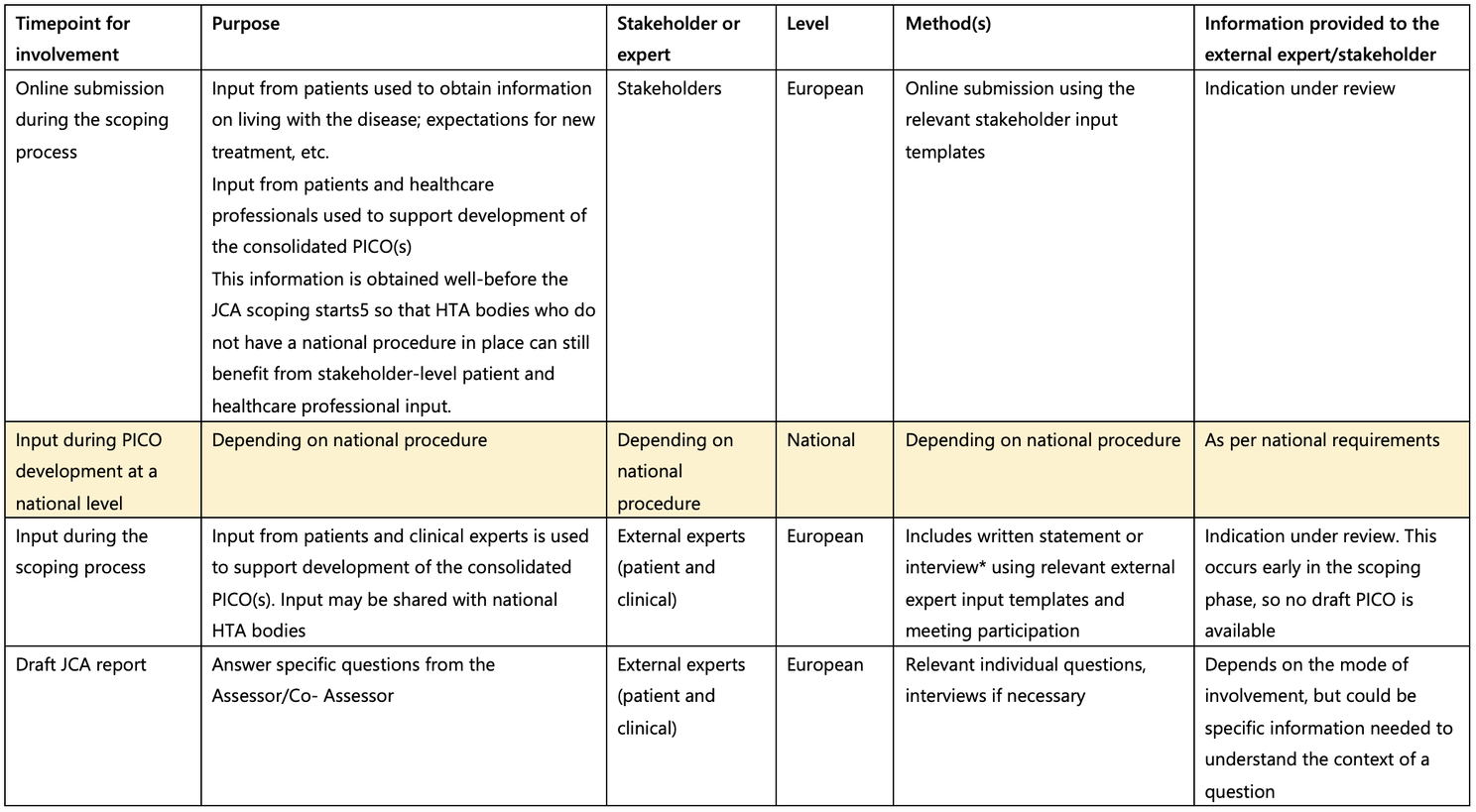

*An interview will take place between the external expert and Assessor/ Co-Assesor/ Secretariat. After the interview, a summary is shared with the external expert for their validation of the content.

Related News
Read more about our work in the field